Teachers As Policy Actors
An annual gathering where educators drive policy conversations with elected officials and other stakeholders
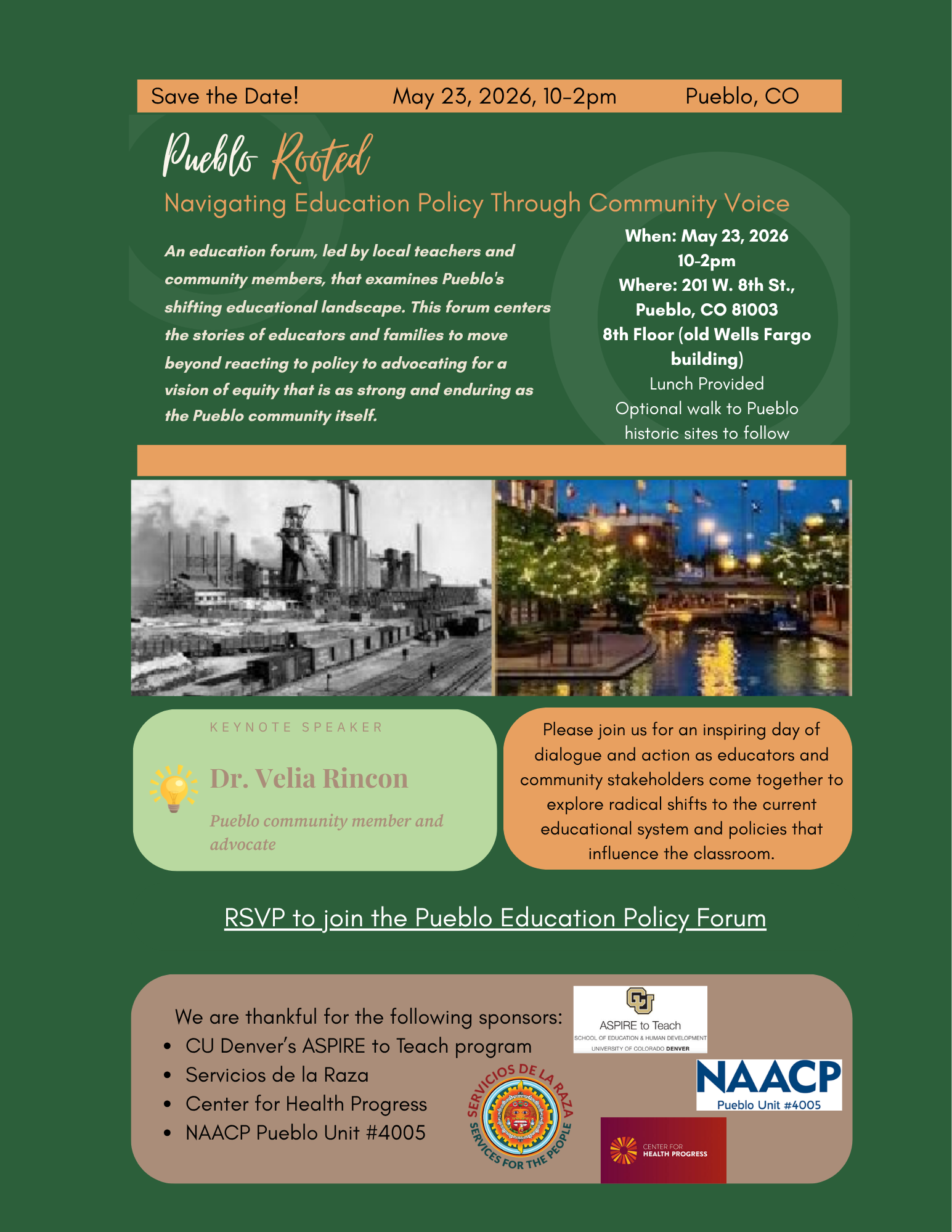
Join us for the 2026 event in Pueblo on May 23!
The context
Across the nation, school districts are seeing the emergence and adoption of policies that marginalize the lived experiences, identities and perspectives of many students and their teachers. For example, anti-Critical Race Theory legislation (UCLA School of Law, 2023) and book bans (Alter, 2024) have been passed around the country, narrowing curricula and stripping schools and teachers of the autonomy to create identity-affirming experiences. Conspicuously missing from many of these official policy discussions are PK-12 teachers who are often “discursively narrated out of the policy making process” (Sheih, 2023a, p. 14). In this paper, we seek to diagram the workings, meanings and outcomes of a purposefully designed space for teachers to come together with community members, policymakers, and legislators. This Policy Forum was enacted during Spring 2024 after a semester-long master’s course on education policy where teachers explored notions of themselves as policy actors (Ball et al., 2011) and ways they might “inhabit that ground and open new opportunities for policy making” (Sheih, 2023a, p. 23).
Perspectives
The Policy Forum design and experience was rooted in notions of power, politics, and agency, concepts that point towards policy assemblage as a guiding frame. As Savage (2020) notes, “assemblages are a result of heterogeneous elements that are brought together into particular strategic relations and with particular desired impacts” (p. 325). A significant aspect of assemblages, we understand notions of power as fluid and contingent, revealing "resistance as...not something speaking back to power from 'the outside' but [as] always embedded and woven into power relations” (p. 329; see also Foucault, 2007). Further, we contend that teachers are not passive recipients of policies nor fully “captured” by them (Sheih, 2023b, p. 167). Rather, teachers are simultaneously exercising agency, “acting alongside and also apart from the acted upon” (p. 167). Here we seek to outline the ways in which the Policy Forum worked to both open up and reveal spaces of dialogue, resistance, and community for teachers. New policy actor roles were explored and new assemblages emerged as “ripe spaces of potentiality and change, always opening new windows and lines of flight towards imagining and assembling something better” (Savage, 2020, p. 332).
The forums
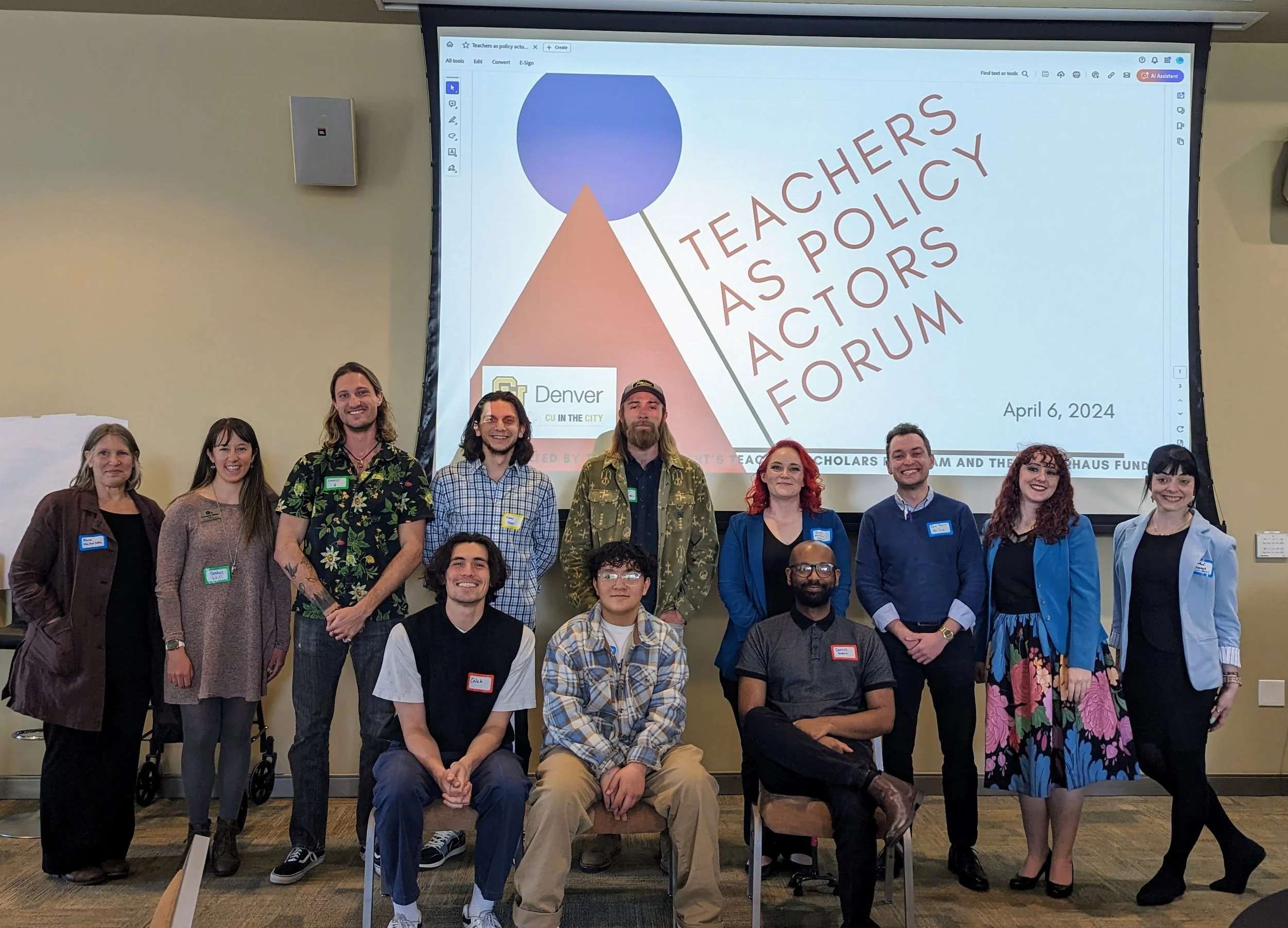
Planning methods. When the summer 2023 policy course ended, the professors learned about a funding opportunity from their university network aimed at sparking community dialogue and action. The professors connected with alumni—both from the summer class and previous years’ courses—to help write a grant application to fund a public education policy event. Through the participatory planning structure, informed by Howe (1993), the group of alumni and professors wrote a successful grant application for the Policy Forum. At its heart, the event would feature the concerns of teachers, and they would lead dialogue with stakeholders including elected officials, policymakers, educators, and school administrators. They then met at least monthly to plan the actual event, formulating a vision through dialogic practices, discussing tasks that needed to be completed, and organizing into groups to complete the tasks in an egalitarian manner. In the end, university faculty tended to handle more of the financial and logistical items while the alumni shaped the vision, norms, and interactive processes for the event. More than 70 people attended the forum, including three elected officials, 10 state policymakers, and an array of academics and teachers. Teachers shared their concerns and research through roundtable discussions with mixed groups of policy stakeholders.
Reflective research methods. After collectively planning and participating in the forum, the teachers and professors collectively decided to conduct a reflective research process. The teacher-presenters answered four reflective questions, which the group collectively devised, and were given the choice to record answers either through video or writing. The questions were: 1) Generally what happened at the forum? 2) What is your call to action after this event? 3) What ideas do you have for future forums? 4) Who are you as a policy actor now? Six teachers answered the questions. To analyze the reflections, a collective mix of the six participants, other teacher presenters, and university partners engaged in a three-phase process. First, the team worked to identify themes and patterns through inductive coding or assigning a usable label to attach meaning to a small body of text (Chandra & Shang, 2019). In essence, the group read or watched each other’s reflections and used comments or took notes to label chunks of the videos or writing. Second, after establishing a list of patterns and themes, the group then worked to combine, eliminate, or pull them apart into workable codes. This happened during regular online meetings. Finally, the group worked together to establish a name for the code, a definition, and quotes that supported the code, further revising and refining thinking as needed. The collective group arrived at three codes, which are shared in Table 1.
Teachers reported that the forum provided a needed space to critique policy and build community
“It was the first time where I felt like I was part of the ideas and thought processes around policy and making things better, bringing in student voice, bringing in the community. I felt like I was a part of that process, and that was something very cool and very unique. I never saw myself being in a role like that before.”
The group worked together to plan another forum in 2025 and is planning to host a 2026 version in Pueblo, Colorado, on May 23.
Results
Our emerging themes showed that teachers want to make education a less controlling space for themselves and their students. They expressed a desire to break certain patterns and find new, humanizing ways to engage with education policy and their students. The Policy Forum, teacher responses indicate, served as a rare space where teachers were valued as much or even more than elected officials and other policy stakeholders. Notions of power become complicated here, as Savage (2020) notes:
No longer, therefore, might we assume that the state is the primary holder of power, from which force is extended in linear or top-down ways, or even that power might be extended smoothly across spaces of governance. Instead, the state is akin to one player in a dynamic game of power, with power flowing in and out of the state, and across political territories, in complex and non-linear ways (p. 329)
Within that space, the teachers crafted meaningful connections with one another, which made them feel more empowered and agentic in deeping their work as policy actors. That sense of agency, it appears from teacher reflection, has extended past the forum itself, as educators have taken different forms of policy action in their respective contexts. One high-school business teacher, for example, infused participatory leadership in his class. Another applied for and received a state-level education policy fellowship in addition to meeting with her school administrators about revising certain school policies. Yet another teacher expressed that he had never felt so affirmed in his work as a policy critic and is in the midst of planning community discussions led by students about school-based violence. Others expressed desires to engage in scholar-activism, writing papers and presenting at conferences in an attempt to move the dial in terms of education policy. Such agentic desires and movements towards the new can be seen as part of what assemblages do. As Thompson and colleagues (2022) noted, “The corporeal body [within an assemblage] is not changed, but what it can be and do is changed” (p. 695).
Significance
While the Policy Forum represented a one-off event, its planning, execution, and lingering effects on teacher agency and action are intriguing. The event appears to have, using Sheih’s (2023a) language, opened new ground and new opportunities for teachers to engage in critiquing, shaping, and considering how to best interpret, implement and find themselves within education policy (p. 23). In some instances, teachers who had only considered themselves receivers of policy were now talking about themselves in terms of being policy critics and entrepreneurs (see Ball et al. 2011). In other cases, teachers doing impressive but siloed policy work at their school sites were able to connect with like-minded educators and build coalitions. In the case of every teacher who presented at the event, their ideas and concerns were dignified by state officials, and that process proved generative in the teachers’ journey as policy actors. Yet, power was not simply shared and agency was not simply attained, as is usually desired. Rather, the forum as policy assemblage created the conditions where power, agency, and contestation could be explored, tried on, and negotiated among multiple discourse communities. Power, understood as “not one solid or stable thing” (Savage, 2020, p. 329), was exemplified as such throughout the forum and beyond. That holds exciting potential for other stakeholders—like teacher educators, unions, professional organizations, or government agencies—looking to authentically and powerfully create spaces to engage teachers around policy issues. In a context that tends to blame, extract, or exclude teachers from policy discussions, we are intrigued by the impacts and possibilities of instead working with teachers to plan both formal events and informal spaces where they can drive the conversation.